
"There are no shortcuts"
"There are no shortcuts"
By 2028, Stockholm Exergi's facility for removing carbon dioxide will be complete. When fully operational, it will be able to remove around 800,000 tonnes of carbon dioxide from the atmosphere per year. That is more than twice the emissions from all domestic flights in Sweden and makes the city one of the first in the world with carbon capture at this scale.
Responsible for leading the project is Egil Nybakk, Director of Beccs at Stockholm Exergi. With more than 20 years of experience in international energy projects, he is now leading one of the most complex climate projects in Europe.
– I have worked on major projects throughout my career, but this is entirely unique in its kind. We are not just building a facility – we are building the foundation of a completely new industry for negative emissions, says Egil.
Following the investment decision in spring 2025, the project moved directly into the construction phase, followed by installation, testing, and careful verification. The goal is to deliver the first liquefied carbon dioxide to the storage company Northern Lights during 2028.
– That means every step must work seamlessly, from capturing carbon dioxide in Stockholm to transporting and safely storing it deep in the sedimentary bedrock beneath the North Sea. There are no shortcuts, says Egil.
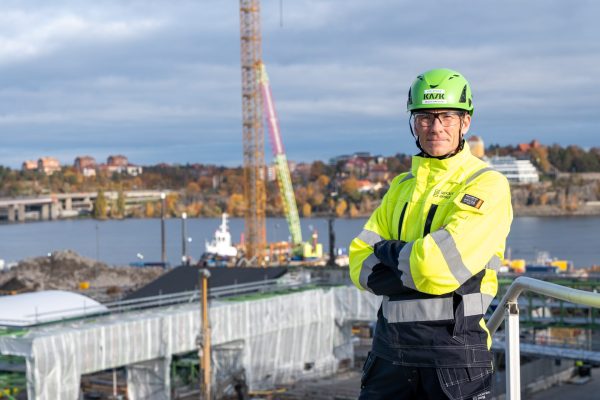
As Beccs Director, Egil is responsible for the project as a whole: organisation, risk management, and delivery. He leads a team of more than 150 people and works daily alongside some of the world’s most experienced technology and construction companies.
– I have managerial responsibility, but I am also deeply involved in strategic matters and the dialogue with our suppliers. The safety principle is crystal clear: “Safe way or no way”. That is how we build long-term trust, both internally and externally, says Egil.
Coordinating a large number of actors, technologies, and regulatory frameworks is, according to Egil, the greatest challenge.
– The hardest part is the complexity and getting all the pieces to work together. But every time we solve a key problem, I feel pride in the team, he says.
But for Egil, the project is not only about technology and timelines – it is also about a personal shift.
– I have spent my entire career in oil and gas, helping build energy systems that have created prosperity and security. Now I feel a responsibility to use everything I have learned for the climate and for future generations. I cannot think of anything more meaningful to work on, and I notice that my children are extra proud of their dad now, says Egil.
When Egil looks ahead, his vision is as much about people’s experience as about climate impact.
– I want people passing through Värtan in a few years to feel pride. Pride that the facility actually contributes to slowing climate change, and that we have built something that works, is safe, and is a natural part of the city of Stockholm, he says.
And looking even further ahead, the goal is clear:
– I hope that in ten years we can see that Beccs Stockholm was a pioneer of a new industry that forms an important part of Europe’s climate strategy
