
800,000 tonnes a year. That is how much carbon dioxide Stockholm Exergi’s facility in Värtahamnen is designed to capture, more than the annual emissions from all road traffic in Stockholm. But behind that figure lies an almost unimaginable level of detail: thousands of technical documents, hundreds of pipe joints where systems from different suppliers must fit together to the millimetre, and companies from several countries working together in perfect coordination.
Anna Gabrielsson is at the centre of it all, leading the engineering work for Stockholm Exergi’s BECCS project. Her team of around 20 engineers defines the technical requirements and reviews the work delivered by a dozen suppliers from across Europe, ensuring that everything is correct and works together as one integrated system.
“We play an important role in making sure the facility works as a whole in the end. The technical perspective is what we bring to the project,” she says.
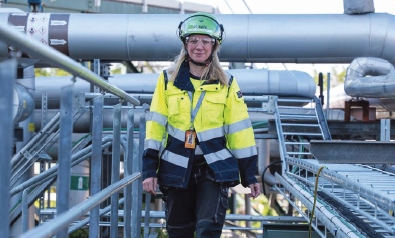
Anna has a degree in chemical engineering and has worked at Stockholm Exergi for ten years. A year and a half ago, she was invited to join what would become one of Europe’s most ambitious climate projects, a challenge on a scale unlike anything she had taken on before.
“I’m used to leading large projects, but nothing on this scale. It’s something else entirely.”
At the heart of Anna’s work is coordinating the review of technical documentation, including drawings, process descriptions and calculations. Much of it involves detailed flow diagrams showing how flue gases and other flows move through the facility, where instruments are located and what dimensions the pipes need to be.
This is where potential problems can hide.
In projects of this size, different parts of the facility are delivered by different contractors. That means that, for example, a pipe supplied by one contractor must connect with a pipe supplied by another. They need to match in dimensions, pressure and wall thickness, and meet at exactly the same point. If the details do not line up, problems can arise later in construction, when they are both more expensive and more difficult to fix.
“Small details like these may seem insignificant, but every error leads to adjustments at a later stage, which affects the entire project.”
This is precisely where Anna’s role becomes crucial. Each contractor is responsible for its own part of the project, but where the technical systems meet, her team acts as the link between them. Altogether, they manage thousands of documents.
Keeping the overall technical picture together is about more than reviewing documents. It also means getting people from across Europe to work towards the same goal.
A large part of Anna’s work therefore involves identifying clashes before they occur on site and making sure that any change made by one contractor is communicated immediately to everyone else affected by it.
“The hardest part is working with different cultures and ways of doing things. You have to make sure everyone has the same understanding of what has been agreed on. It’s not enough to hold a meeting, you need to know that everyone leaves the room with the same understanding.”
In a project of this scale, Anna knows that challenges are inevitable. In her view, it is the team culture that determines whether those challenges become costly.
“The key is to quickly shift the focus to how we can solve the problem together. Everyone knows that if something needs attention, they should raise it straight away, and that is always received positively. It is essential if we’re going to keep moving forward.”
When a particularly difficult issue requires extra attention, a dedicated task force is assembled, bringing together the right people from the right companies to work on it until the problem is resolved.
“We had an unexpected pressure drop in one part of the system, which required adjustments late in the process and therefore involved large parts of the project team. The feeling when we finally found a technical solution is hard to beat. It always feels like a small victory to cross a problem off the list.”
That is the feeling Anna looks for in her day-to-day work, and one day it will be reflected in the bigger result.
“These processes have been used before, but the way we connect them to the existing biomass-based combined heat and power plant to capture carbon dioxide is new. It’s exciting to be part of a first-of-its-kind facility on this scale, and it really feels like contributing to something bigger.”
In the near future, the facility will be operational, enabling 800,000 tonnes of carbon dioxide a year to be stored in geological formations beneath the North Sea.
